
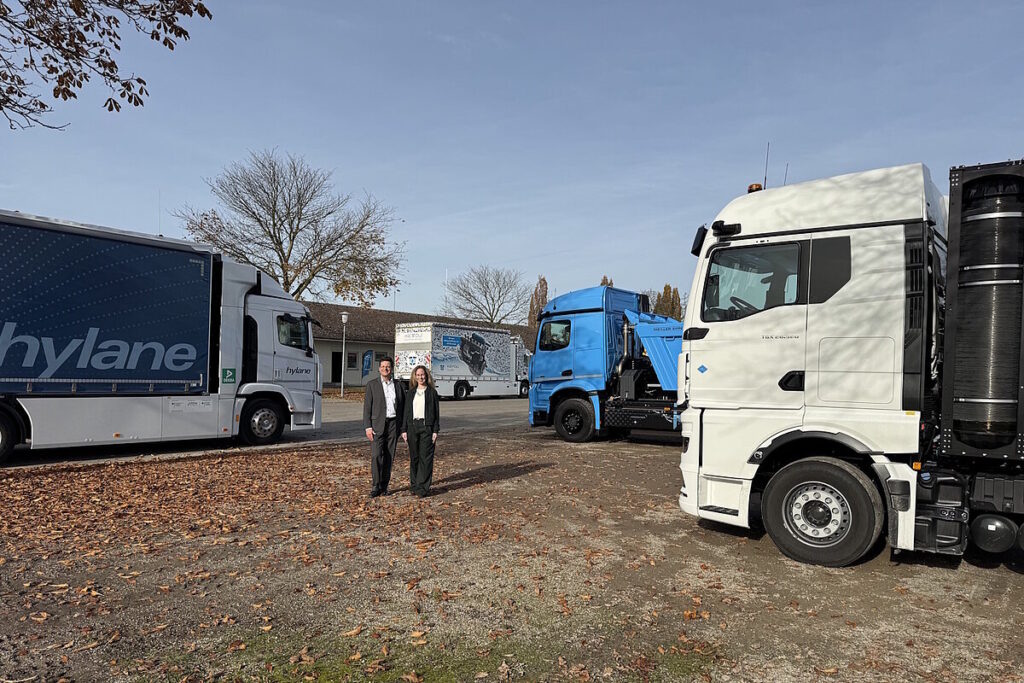
Strategic Decarbonization in the Rhine-Neckar Region
The transformation of Europe’s heavy-duty transport sector is accelerating. The opening of the new hydrogen refueling station (HRS) in Frankenthal, Germany—a centerpiece of the ambitious H2Rivers project—is more than a technological milestone. It represents a strategic leap toward establishing zero-emission transport corridors that connect the industrial heartlands of Germany with the rest of Europe.
1. Strategic Location: The Heart of Rhine-Neckar
Developed as a joint venture between H2 MOBILITY Deutschland and the chemical giant BASF, the Frankenthal station is positioned as a critical logistics node.
- Accessibility: Located near the A6 motorway (Ludwigshafen Nord junction) and adjacent to BASF’s massive production site.
- Corridor Impact: For the TSL (Transport-Spedition-Logistyka) sector, this location is vital. it enables the seamless integration of hydrogen-powered fleets into one of Europe’s busiest trade routes, linking Southern Germany with France and the Benelux countries.
2. Technical Performance: Built for Heavy-Duty (FCEV)
Unlike early-generation stations focused on passenger cars, Frankenthal is engineered for scale and heavy-duty performance:
- 350-bar Technology: Optimized for the rapid refueling of trucks and buses.
- Capacity: Current throughput allows for the refueling of up to 30 trucks or buses daily (approx. 800 kg of H2).
- Future-Proofing (2027 Perspective): Plans are already in place to double this capacity, allowing three vehicles to refuel simultaneously (two 350-bar and one 700-bar dispenser for light vehicles).
3. The H2Rivers Ecosystem: From Production to Consumption
The H2Rivers initiative is a premier example of a Hydrogen Valley. It doesn’t just build „islands” of infrastructure; it integrates the entire value chain:
- Production: Utilizing green hydrogen compliant with RFNBO standards.
- Infrastructure Cluster: Part of a regional network including Mannheim, Ludwigshafen, and Heidelberg.
- Lead Users: Partnering with companies like BASF and public transport operators (rnv) who are deploying fuel-cell buses and hydrogen-powered waste collectors.
4. Lessons Learned: Challenges and Solutions
Hydrogen projects are often „70% bureaucracy and 30% technology.” The following table summarizes the key takeaways from the H2Rivers and H2Rhein-Neckar projects:
| Area | Challenge / Situation | Implemented Solution | Recommendation |
| Management | 2-year station delay left vehicles without fuel. | High-level coordination and renegotiation of grant timelines. | Synchronize production and consumption timelines from Day 1. |
| Environment | Protected lizard species on the construction site. | Expert nature surveys and physical relocation of fauna. | Start environmental/fauna audits 6-12 months before filing for permits. |
| Acoustics | Compressor noise in highway-adjacent areas. | Iterative station redesign; using firewalls as acoustic screens. | Noise assessments must reflect high-load scenarios, not just idle state. |
| Suppliers | Insolvency of a key vehicle manufacturer (Category N1). | Switched to serial vehicles, modifying the technical concept. | Ensure ownership rights transfer early in contracts with startups/prototypes. |
| IT & Data | Manufacturers refused to share „CAN-Bus” technical data. | Developed proprietary estimation models for fuel cell performance. | Mandatory data sharing for research must be written into procurement specs. |
5. Industrial Insights: „Did You Know?”
The „Frosty Refueling” Problem
To refuel a heavy truck in minutes, hydrogen must be pre-cooled to nearly -40°C. This requires massive heat exchangers at the station—a significant engineering challenge and cost factor often overlooked in smaller projects.
The „Anchor Customer” (Financial Anchor)
Documentation emphasizes that no station can survive in the current market without an Anchor Customer (e.g., a local bus company). This guaranteed demand allows the station to remain open for smaller private logistics firms that are still in the testing phase.
Safety and the „Gas Myth”
H2Rivers involved training hundreds of emergency responders. Data shows that in accidents, hydrogen-powered vehicles are often safer than traditional gasoline tankers; hydrogen dissipates instantly into the atmosphere rather than pooling and burning on the ground.
Summary
The implementation of hydrogen trucks is no longer a question of „if” but „when” and „where.” The Frankenthal example proves that through industrial partnership and strategic government support (€1.3M in funding for this station alone), hydrogen is becoming a viable, zero-emission alternative to diesel in the hardest-to-decarbonize sector: heavy transport.
This article was prepared for stanur.com based on data from H2 MOBILITY, H2Rivers, and wodorowa.eu.