
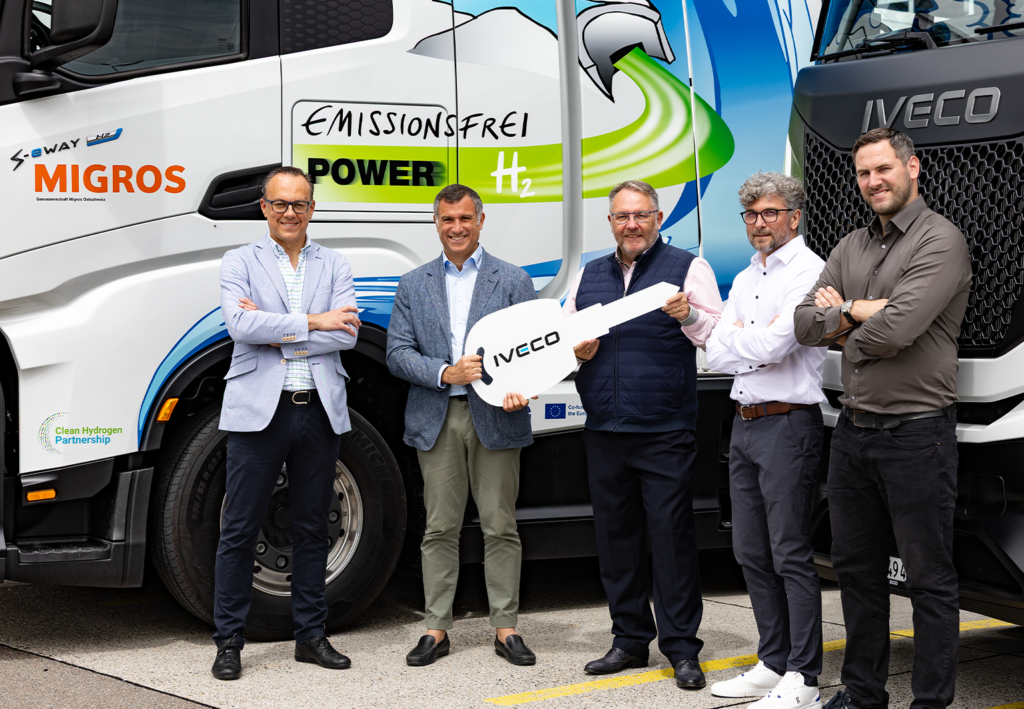
Swiss Maturity: How Migros Ostschweiz Closes the „From the Region, For the Region” Hydrogen Loop
Switzerland is no longer just testing hydrogen technology; it is deploying it within a closed, local ecosystem. While the rest of Europe debates the future of drivetrains, the Migros Ostschweiz (MOCH) cooperative is proving that combining global technology with regional fuel production is the most logical business choice.
The Swiss model, implemented under the H2Haul project, rests on three distinct pillars: „river-to-wheel” production, road tax exemptions, and an elite fleet of vehicles.
1. The Strategy: Data-Driven Decarbonization
Migros is not a newcomer to H2. Having operated hydrogen vehicles since 2020, the company is now scaling up from 18-ton trucks to 44-ton tractor-units, which form the backbone of their logistics.
The „CO2 Insights” Algorithm
The investment in hydrogen is based on mathematical optimization. In collaboration with the Empa Institute, Migros developed a digital tool that analyzes the topography, cargo weight, and distance of every route.
- The Logic: On steep Alpine climbs in Grisons, where harsh winters drain Battery Electric Vehicle (BEV) performance, Fuel Cell Electric Vehicles (FCEVs) are the only effective solution.
- The Goal: This strategy aims for a 70% reduction in CO₂ emissions by 2030, saving 15,000 tons of CO₂ annually.
2. The Elite Fleet: IVECO S-eWay Fuel Cell
The new heart of the fleet consists of two IVECO S-eWay Fuel Cell tractors. These are part of an elite pre-series production—only 15 such vehicles exist on European roads, with four allocated to Switzerland.
- Swiss DNA in the Drivetrain: Developed by FPT Industrial in Arbon, Switzerland, the system features an innovative e-Axle that integrates the motor and transmission into a single housing, freeing up space for hydrogen tanks.
- Performance: The trucks achieve a real-world range of 400 km on a single 20-minute fill (approx. 70kg of H2).
- Winter Engineering: A specialized system prevents the water byproduct of the fuel cell reaction from freezing, ensuring the vehicle remains operational in sub-zero Alpine conditions.
3. Financials: The LSVA Tax as a Catalyst
In Switzerland, hydrogen vehicles are a tool for cost optimization thanks to their exemption from the LSVA (performance-related heavy vehicle charge).
| Parameter | Diesel Vehicle | Hydrogen Vehicle (FCEV) |
| Purchase Price (CAPEX) | ~$150,000 | ~$250,000 |
| Annual LSVA Fees | ~$15,000 | $0 |
| Annual Fuel Cost | ~$30,000 | ~$20,000 |
| TCO Verdict | Standard | Competitive after 3-4 years |
The road tax exemption makes the business model financially viable despite the higher initial purchase price of the vehicle.
4. Production: Green Hydrogen „From the Neighborhood”
Migros adheres to the principle of „Aus der Region, für die Region” (From the region, for the region), effectively eliminating the need for fossil fuel imports.
Hydro-powered Electrolysis
Green hydrogen is produced at the Kubel hydroelectric plant (St. Gallen).
- The Setup: A 1 MW electrolyzer produces 200 tons of H₂ per year.
- Energy Source: Using river energy ensures 100% CO₂ neutrality.
- Logistics: The fuel is supplied to the AVIA Osterwalder station in Gossau, located directly adjacent to the Migros logistics hub. To refuel 70 kg in 20 minutes, the hydrogen is pre-cooled to -40°C before being dispensed at 700 bar.
5. Scale: 10 Million Kilometers of Experience
Switzerland is the only country in Europe with such a massive backlog of operational data. Hydrogen fleets here have collectively covered 10 million kilometers.
Domenico Nastasi of IVECO Switzerland describes the country as a „living laboratory.” The data gathered by Migros Ostschweiz flows directly back to engineers to refine the mass-production models scheduled for 2028.
Summary: Why Migros Wins
- Local H2 Source: Low costs and zero emissions through hydropower.
- Tax Incentives: The LSVA exemption drastically reduces operational costs.
- Advanced Analytics: Choosing the right drivetrain (H2 vs. Battery) based on terrain data.
- Energy Independence: Decoupling logistics from global oil price fluctuations.
The Migros case proves that energy independence and climate protection can go hand-in-hand with corporate profitability.