
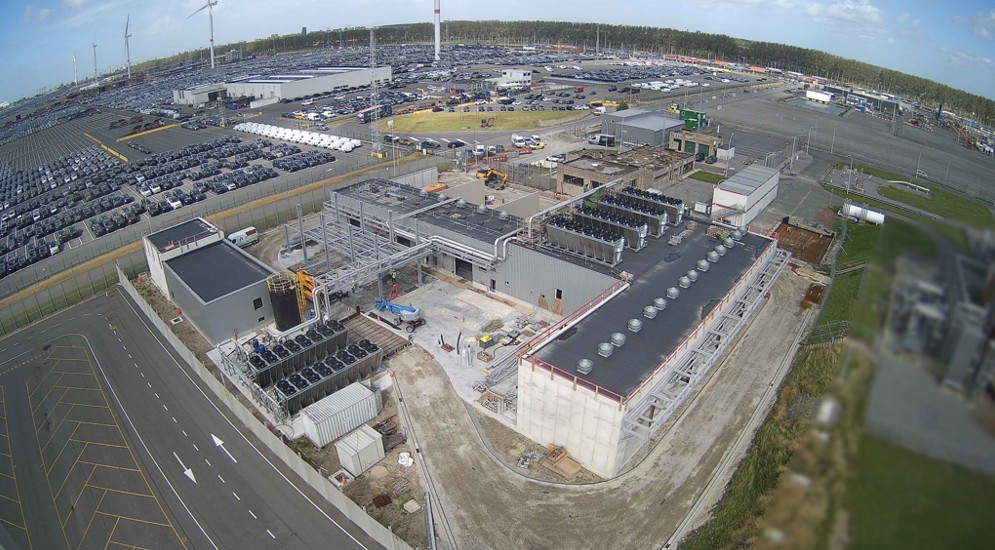
Zeebrugge has emerged as a strategic hydrogen node for Europe, thanks to the synergy between offshore wind energy and robust port infrastructure. The Hyoffwind project is one of the first in Europe to solve the „chicken and egg” dilemma—the lack of coordination between renewable energy production and hydrogen demand—at an industrial scale.
As a designated Project of Common Interest (PCI) by the European Union, Hyoffwind is critical for the decarbonization of heavy transport and industry across the continent.
1. Technical Architecture and Performance
The success of Hyoffwind relies on scalable, proven technologies capable of producing high-purity hydrogen (Class 5.0) suitable for both fuel cell trucks and chemical manufacturing.
Key Technical Parameters (Phase I)
| Parameter | Specification |
| Installed Capacity | 25 MW |
| Technology Provider | John Cockerill Hydrogen |
| Electrolyzer Type | Pressurized Alkaline |
| Annual Production | ~3,700 tons (approx. 10 tons/day) |
| Energy Source | 100% Renewable (Offshore Wind + PV) |
| $CO_2$ Reduction | 25,000 tons per year |
Why Alkaline Technology?
The heart of the plant consists of four 6.25 MW alkaline stacks. Unlike PEM (Proton Exchange Membrane) technology, alkaline electrolysis is a mature industrial solution that does not rely on precious metals like iridium or platinum. This ensures more predictable OPEX and a longer system lifespan, which is vital for industrial stability.
2. The Integrated Value Chain: From Wind to Wheel
Hyoffwind is designed as a multi-functional logistics hub. The green hydrogen produced flows through three primary channels:
- Tube Trailer Filling Center: Hydrogen is compressed (up to 350/500 bar) and loaded onto trailers for distribution to DATS 24 refueling stations and industrial clients.
- Gas Grid Integration: The facility allows for hydrogen injection (blending up to 2%) into the Belgian gas network operated by Fluxys.
- Grid Balancing (Demand Response): The plant acts as a stabilizer for the Elia power grid, absorbing surplus wind energy during peak production periods.
3. The Consortium: Architects of Success
A project of this magnitude requires a strategic alliance of market leaders, each closing a specific gap in the value chain:
- Virya Energy (Developer): Provides green energy from offshore farms and ensures demand through its links to the Colruyt Group.
- John Cockerill (Technology): Delivers the high-efficiency electrolysis stacks and purification systems.
- Messer (Logistics): Manages the compression, filling, and distribution of $H_2$ 5.0 grade gas.
- BESIX (Engineering/EPC): Responsible for the civil engineering and infrastructure construction in the Port of Zeebrugge.
4. Real-World Lessons for the European Market
Hyoffwind serves as a „survival school” for the hydrogen business. Here are five hard-earned lessons for the 2026 market:
- Vertical Integration is Mandatory: Do not build an electrolyzer without controlling the end-user. Hyoffwind succeeded because it has a „captive fleet” (Colruyt Group) ready to consume the gas.
- Scale in Small Steps: While some giants failed by planning gigawatt-scale plants too early, Hyoffwind started with 25 MW—enough to be profitable and serve a real fleet without drowning in operational costs.
- Location is 50% of the Success: Hydrogen is expensive to transport. Producing it directly at the port and near major transport corridors (E40/E17) minimizes distribution costs.
- Alkaline is a „Safe Haven”: In a world of supply chain crises, alkaline technology offers predictable maintenance costs compared to newer, metal-intensive alternatives.
- Subsidies are the Bridge: The €30M in support from NextGenerationEU was essential to bridge the price gap between green and „grey” hydrogen until the market matures.
5. Glossary: Guide to Hyoffwind Technology
- LCOH (Levelized Cost of Hydrogen): The average cost of producing 1kg of $H_2$ over the plant’s life. This is the ultimate KPI for project profitability.
- Wodór 5.0 (Purity Class): 99.999% pure hydrogen. Required by fuel cell manufacturers (ISO 14687) to prevent irreversible damage to truck engines.
- Balance of Plant (BoP): All supporting systems (water treatment, cooling, compressors) outside the actual electrolyzer stacks.
- Tube Trailer: A specialized semi-trailer used to transport compressed hydrogen gas at pressures of 200 to 500 bar.
Summary for wodorowa.eu:
The Belgian model demonstrates that hydrogen is not „the new natural gas” that will flow everywhere. Instead, it is the fuel of local ecosystems. When you have the energy (wind), the factory (Hyoffwind), and the client (Colruyt trucks) within a 50km radius—the business case holds.