
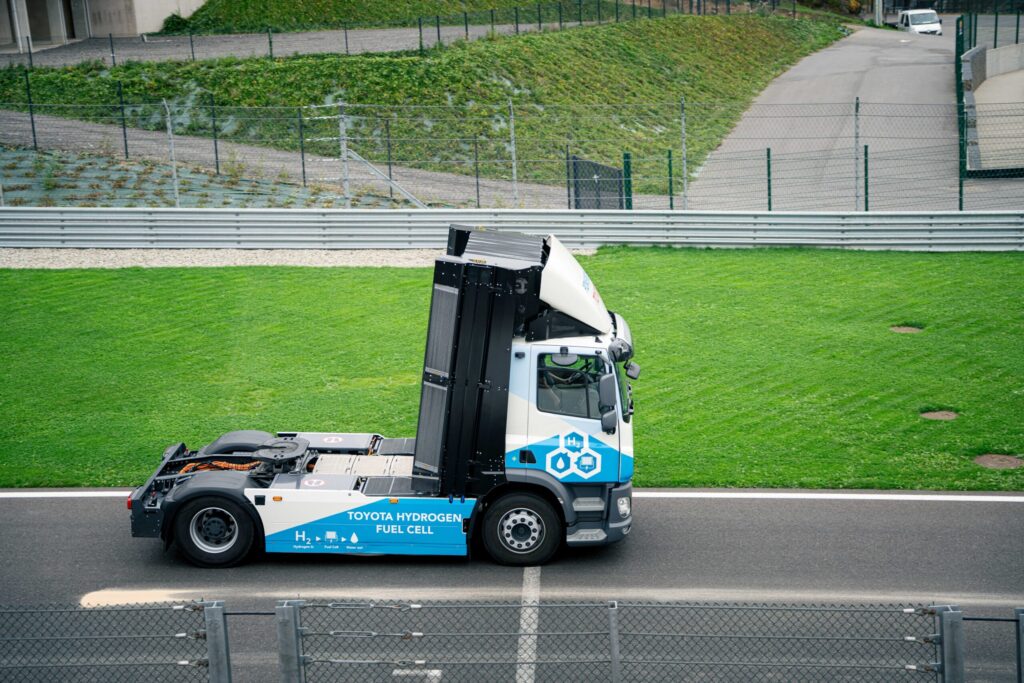
In October 2025, the iconic Spa-Francorchamps circuit shifted from racing engines to the silent power of fuel cells. During a landmark demonstration, the Cluster Tweed, Virya Energy, and Colruyt Group showcased that the Belgian hydrogen sector is no longer in a „pilot” phase—it has entered real-world operational readiness for heavy-duty logistics.
The event served as a 1:1 scale proof of concept, demonstrating that 44-ton hydrogen-electric trucks (FCEVs) are ready to replace diesel in segments where battery electrification falls short due to weight and charging constraints.
1. The Infrastructure Pillars: Virya Energy & Hyoffwind
The „Belgian Model” addresses the industry’s greatest challenge—the „chicken and egg” dilemma—by simultaneously building the supply (production) and the demand (fleet).
- Production (Hyoffwind): Located in the strategic Port of Zeebrugge, this industrial-scale electrolysis plant is on track for full operation in 2026. It will leverage Belgium’s massive offshore wind capacity to produce 100% green hydrogen.
- Distribution (DATS 24): Under the DATS 24 brand, Virya Energy is aggressively expanding a network of high-capacity hydrogen refueling stations (HRS) to ensure that logistic operators have fuel wherever they need it.
2. The Zero Emission Transport (ZET) Program
Colruyt Group, one of Belgium’s retail giants, has set a hard target: zero-emission freight transport by 2030. This strategy, titled the Zero Emission Transport (ZET) program, is moving from ambition to asphalt.
- Real-World Integration: Through the European H2Haul project, Colruyt is the first retailer in the country to integrate 44-ton hydrogen trucks into daily distribution cycles.
- Segmented Approach: CEO Stefan Goethaert clarified that while light-duty transport may favor batteries, hydrogen is the „prime choice” for high-tonnage vehicles operating on tight schedules with heavy loads.
3. Technical Specifications: The 44-Ton H2Haul Fleet
The trucks demonstrated at Spa-Francorchamps are specifically engineered for the high-demand requirements of regional distribution.
| Parameter | Technical Specification |
| Gross Vehicle Weight (GVW) | 44,000 kg (44 tons) |
| Drivetrain Type | Fuel Cell Electric Vehicle (FCEV) |
| Fuel Cell Power | 100 kW – 120 kW (Modular) |
| Electric Motor Power | ~350-360 kW (Continuous) |
| H2 Storage Capacity | ~40 kg (7 carbon fiber cylinders) |
| Operational Pressure | 350 bar (Logistics standard) |
| Operational Range | 400 – 450 km |
| Refueling Time | 15 – 20 minutes |
| Buffer Battery | 210 kWh Li-ion (Supports peak demand) |
4. Roadmap to 2030: Synchronization is Key
The Belgian strategy relies on a strictly timed correlation between production and fleet expansion:
- 2026–2027: The commissioning of the Hyoffwind plant will trigger a mass scale-up of refueling capacity across the DATS 24 network.
- By 2030: Full synchronization will be achieved, with green hydrogen supply meeting the total demand of Colruyt Group’s fleet and its industrial partners.
Summary for wodorowa.eu:
The Belgian showcase proves that hydrogen is no longer a technical curiosity. By combining offshore wind (Virya), industrial electrolysis (Hyoffwind), and retail logistics (Colruyt), Belgium has created a closed-loop economy. This model demonstrates that for heavy-duty transport, the transition from diesel to hydrogen is technically viable and operationally competitive.