
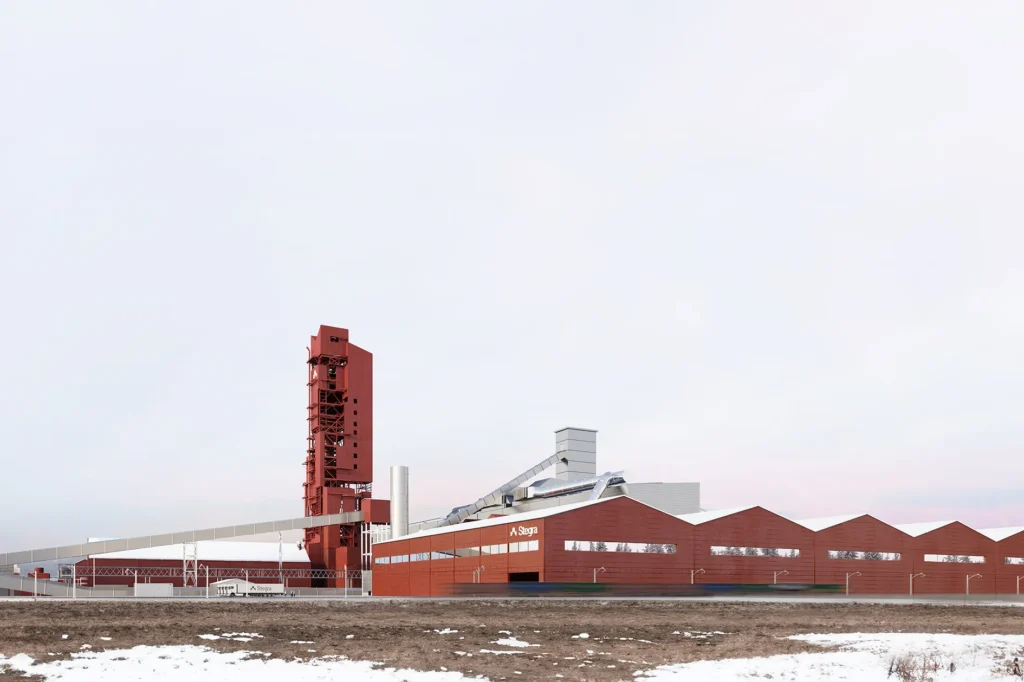
How Sweden is Building the World’s First Large-Scale Hydrogen Steel Mill
In a world dominated by debates over decarbonization, few projects have a more tangible and gargantuan impact than Stegra (formerly known as H2 Green Steel). Located in Boden, Northern Sweden—just a few dozen kilometers from the Arctic Circle—the foundation for a new industrial revolution is being laid. Here, the vision of a hydrogen economy stops being a presentation slide and becomes thousands of tons of steel, concrete, and cutting-edge electrolysis technology.
1. Why Boden? The Geographic Advantage
The investment in Boden, valued at €6.5 billion, is one of the largest financial undertakings in modern Swedish history. The choice of location is no accident; it is based on a unique confluence of natural resources:
- Iron Ore Access: Proximity to the LKAB mines in Kiruna and Malmberget ensures a steady supply of high-grade ore, essential for the hydrogen-based direct reduction process.
- Green Energy Surplus: Northern Sweden (Price Zone SE1) possesses vast surpluses of hydroelectric and wind power. Consequently, energy prices are among the lowest in Europe, directly reducing the cost of hydrogen production.
- Established Infrastructure: The Malmbanan railway line and the Port of Luleå allow for efficient transport of finished products to European markets.
2. The Technology: A Symbiosis of Three Installations
Stegra is not just a steel mill; it is an integrated complex where three key plants operate within a single closed ecosystem.
I. The Electrolyzer: Scaling to the Limit
The heart of the complex is a 700+ MW electrolysis plant supplied by thyssenkrupp nucera.
- Technology: Alkaline Water Electrolysis (AWE).
- Function: It produces enough green hydrogen to completely eliminate the need for coal and coke in the metallurgical process.
II. The Direct Reduced Iron (DRI) Tower: A Chemical Revolution
Traditional blast furnaces emit massive amounts of $CO_2$ by using coke to remove oxygen from iron ore. Stegra replaces this with Midrex DRI technology adapted for 100% hydrogen.
- The Process: Inside a 145-meter tower, hot hydrogen „strips” oxygen from the iron ore.
- The Byproduct: Instead of carbon dioxide, only pure water vapor ($H_2O$) is emitted.
- Result: Sponge Iron (DRI)—a nearly pure metal ready for the final stage.
III. The Electric Arc Furnace (EAF): The Final Link
The sponge iron, along with steel scrap and alloys, is melted in an Electric Arc Furnace (EAF) powered exclusively by green energy. This produces liquid steel that is cast and rolled to specific customer requirements.
3. Economic and Market Analysis: The „Green Premium”
Stegra proves that with the right scale, the market is ready to pay a premium for carbon-free products.
- Secured Financing: In January 2024, Stegra finalized a €4.2 billion debt financing package supported by over 20 financial institutions, including the European Investment Bank (EIB).
- Binding Off-take Agreements: Before breaking ground, Stegra secured multi-billion-euro contracts with industry leaders:
- Automotive: Scania, Mercedes-Benz, BMW, and Volkswagen.
- Consumer Goods: Purmo Group and ZF Group.
4. Competitive Analysis: Stegra vs. HYBRIT
While Northern Sweden hosts two major green steel initiatives, their strategies differ significantly:
| Feature | Stegra (Boden) | HYBRIT (SSAB/Vattenfall) |
| Business Model | Greenfield (Built from scratch) | Brownfield (Modernizing existing mills) |
| Strategy | Aggressive scaling to full commercial size | Pilot and demonstration phase approach |
| Hydrogen Storage | Real-time production flexibility | Underground Lined Rock Cavern (LRC) |
| Target Market | Premium / First-movers | Mass-market total portfolio replacement |
5. Solving Global Industrial Problems
The hydrogen technology implemented by Stegra addresses critical structural issues that traditional coal and gas technologies can no longer solve:
- Hard-to-Abate Decarbonization: Hydrogen is the only chemical reductant capable of replacing carbon in the iron-making reaction where electricity alone cannot.
- ETS Price Protection: By eliminating $CO_2$ emissions (reducing them by 95%), Stegra removes the risk of rising EU ETS carbon credit costs.
- Resource Sovereignty: Locally produced green hydrogen (from Swedish wind/hydro) provides independence from volatile global natural gas markets.
- Scope 3 Requirements: Major corporations are now forced by ESG regulations to clean their entire supply chain. Stegra sells them „certification peace of mind.”
6. Challenges and Risks
Despite its pioneering status, the project faces significant hurdles:
- Grid Stability: Drawing 700 MW (10% of Northern Sweden’s capacity) requires perfect coordination with Svenska kraftnät.
- Logistics: The Malmbanan railway is heavily congested; Stegra is considering marine transport from Brazil (Vale) as a strategic backup.
- Labor: Recruiting 3,000 workers in a town of 25,000 residents necessitates massive training programs with local universities.
Summary
Stegra is more than a factory; it is the testing ground for Europe’s entire hydrogen strategy. If the first commercial batch of hydrogen-produced steel rolls off the line in 2026, it will signal to the world that the decarbonization of heavy industry is no longer a dream—it is an operational reality.
This analysis is based on Stegra reports, Midrex technical documentation, and market data from BloombergNEF and the IEA.