
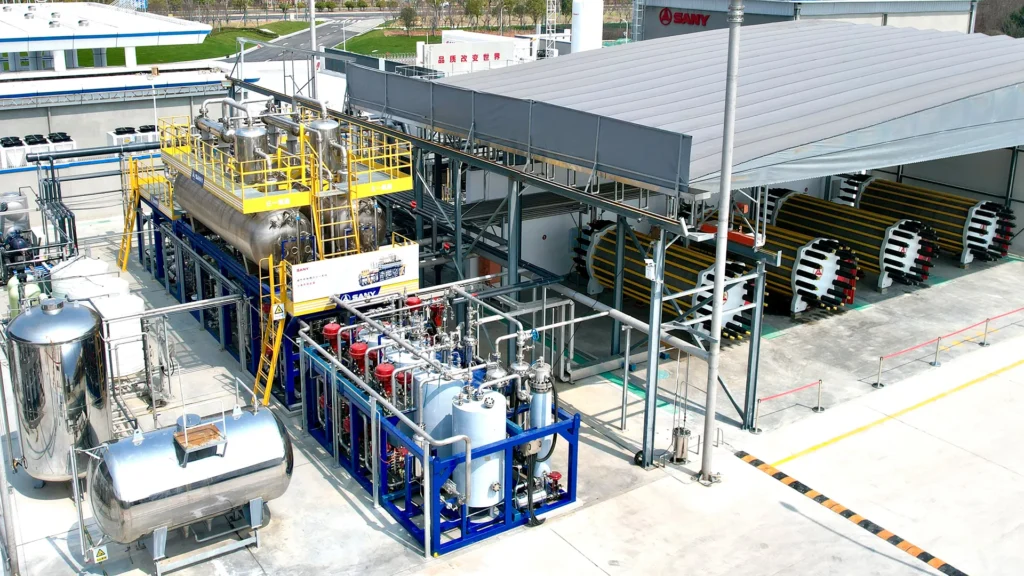
Sany Enters the Australian Market: Gigawatt-scale Western Green Energy Hub Gains Momentum
This could be a turning point for the global green hydrogen market. Chinese industrial equipment giant Sany has officially partnered with InterContinental Energy (ICE) to progress one of the world’s largest hydrogen hubs – the Western Green Energy Hub (WGEH) in Western Australia. The goal? A Final Investment Decision (FID) by 2029 and production measured in millions of tonnes.
1. Scale That Changes the Rules of the Game
The Western Green Energy Hub (WGEH) is a project of unimaginable proportions. Located in the Goldfields-Esperance region, it covers an area of over 2.2 million hectares (larger than Wales). The target parameters include:
- 70 GW of power from hybrid wind and solar farms.
- Production of up to 3.5 million tonnes of green hydrogen per year (or 20 million tonnes of green ammonia).
- Installation of approximately 3,000 wind turbines and 60 million solar modules.
- Total Investment: Estimated at 100 billion AUD (~65 billion USD).
2. Sany and InterContinental Energy Partnership: Why It Matters
The recently signed Feasibility Phase Agreement includes SANY International Development and leading South Korean entities (such as KEPCO) in the core group of Stage 1 implementers. Sany is not just a heavy machinery manufacturer; it is a leader in low-emission technologies, providing:
- Massive Production Capacity: Sany operates automated „Lighthouse Factories” with an electrolyzer production capacity of 2 GW per year.
- Storage Technology: The company will supply Energy Storage Systems (BESS), crucial for stabilizing gigawatt-scale electrolyzers powered by volatile wind and solar energy.
- „Giga-scale” Experience: Sany’s involvement guarantees equipment supply, which is invaluable given current global supply chain bottlenecks.
3. Technical Deep Dive: Sany Hydrogen Technology
Sany Hydrogen Energy has emerged as a leader in pressurized alkaline water electrolyzers (AWE), modular systems, and PEM technology. Their equipment is designed for extreme conditions and seamless integration with renewable energy sources (RES).
Expanded Product Portfolio
- Pressurized Alkaline Electrolyzers: Models from 200 to 2000 Nm³/h.
- Modular Alkaline Electrolyzers: Models from 500 to 3000 Nm³/h (the S-3000 model offers record-breaking capacity).
- PEM Electrolyzers: Models from 50 to 200 Nm³/h (e.g., P-200), featuring high current density (>25,000 A/m²).
- „Multi-in-One” Systems: Solutions with capacities up to 4800 Nm³/h (4×1200 configuration).
Key Technical Specifications
- Energy Efficiency: DC power consumption for the E-series ranges from 4.2 to 4.4 kWh/Nm³, significantly outperforming the industry standard of 4.6 kWh/Nm³.
- Hydrogen Purity: After passing through BOP (Balance of Plant) purification systems, hydrogen reaches a purity of ≥99.9999% with a dew point of -70°C.
- Working Load Range:
- E-Series (Pressurized): 20% – 120%.
- S-Series (Modular) & P-Series (PEM): An impressive 5% – 120%, ideal for volatile Australian wind and solar conditions.
- Response Time: „Hot Start” for PEM and Modular systems is under 10 seconds.
Technology Comparison Table
| Parameter | E-Series (Pressurized) | S-Series (Modular) | P-Series (PEM) |
| Max Capacity (Nm³/h) | 2000 | 3000 | 200 |
| DC Consumption (kWh/Nm³) | 4.2 – 4.4 | 4.3 – 4.4 | < 4.3 |
| Load Range | 20% – 120% | 5% – 120% | 5% – 120% |
| Hot Start Time | < 3-5 min | < 10 sec | 10 sec |
4. Innovation and Reliability
- Serviceability: Sany’s modular systems allow for an electrolytic chamber replacement in under 1 hour, with total system downtime below 36 hours.
- Durability: Sany electrodes have undergone a 5000-hour stress test, showing a yearly degradation rate of less than 1%.
- Advanced R&D: Sany operates China’s largest testing platform for electrolyzers (24 MW), allowing simultaneous testing of multiple „multi-in-one” units.
5. Challenges and Roadmap
Despite the enthusiasm, the project faces significant hurdles:
- Environmental Protection: WGEH is undergoing rigorous environmental assessments (EPBC Act). 95% of the land will remain untouched, with a priority on „avoiding impact” on Western Australia’s unique ecosystems.
- Indigenous Partnership: A key stakeholder (10%) is Mirning Green Energy Limited, representing the Traditional Owners – the Mirning people. This is a flagship model for including local communities in the energy transition.
- Stage 1 Goals: Construction of 6 GW hybrid capacity to produce ~330,000 tonnes of green hydrogen per year. FID is expected in 2029, with first production by 2032.
Global Context: Australia as the Fuel Station of the Future
The Australian government’s support through the „Future Made in Australia” initiative (22.7 billion AUD) and the 2 USD/kg hydrogen tax credit is accelerating these mega-projects. The Western Green Energy Hub, powered by Sany’s technology and international capital, shows that the race for green hydrogen dominance has officially entered the industrial phase.
Sources: Sany Hydrogen Energy Technical Brochure 2025/2026, H2 View, PV Tech, First Nations Clean Energy Network, CSIRO HyResource.