
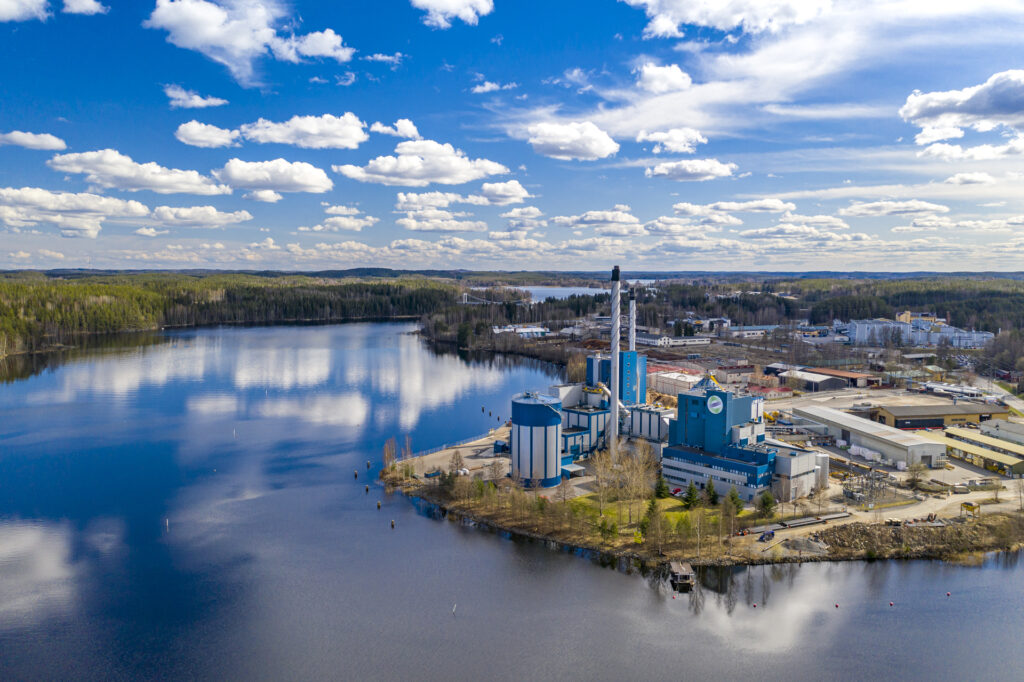
Sector Coupling in Practice: How Nordic Ren-Gas is Redefining the European Hydrogen Strategy
An analysis of Nordic Ren-Gas projects in Tampere, Lahti, Kotka, Mikkeli, Pori, and Kerava leads to a clear conclusion: the future of green hydrogen in Europe is inextricably linked to sector coupling. The Finnish operational model proves that hydrogen does not have to be a difficult-to-transport „fuel of the future”—it can serve as the feedstock for e-methane, which utilizes existing gas and heating infrastructure today.
Key lessons from Ren-Gas operations:
- Waste Heat Value: Renewable fuel production becomes economically viable only when thermal energy from electrolysis and methanation is recovered to support district heating systems.
- Industrial Symbiosis: Utilizing biogenic $CO_2$ (from biomass plants or waste-to-energy facilities) turns problematic emissions into a valuable production raw material.
- Heavy-Duty Transport Readiness: E-methane provides an immediate answer to the decarbonization of logistics and shipping without requiring a costly replacement of entire vehicle fleets with hydrogen-only trucks.
For countries like Poland, this model offers a ready-made development path, showing how to combine the potential of wind farms with the modernization of district heating and transport.
1. Tampere – The Pioneering Transport Hub
The Tampere project is a cornerstone of the Ren-Gas network. It involves a Power-to-Gas (PtG) plant producing renewable e-methane, green hydrogen, and district heat recovered from process waste heat.
Technical and Production Parameters:
| Parameter | Value |
| :— | :— |
| Electrolyzer Capacity | 50 MW (Sunfire, pressurized alkaline) |
| Methanation Capacity | 50 MW (MAN Energy Solutions, catalytic) |
| E-methane Production | 170 GWh/year (Phase I) |
| District Heat Production | 180 GWh/year (CO2-free) |
| Biogenic CO2 Consumption | 40,000 tons/year (from Tammervoima plant) |
| Transport Impact | Fuel for 500–900 heavy trucks (24m liters of diesel equiv.) |
2. Lahti – Large-Scale Decarbonization
The Lahti project is the largest in Finland in terms of electrolyzer capacity, focusing on massive $CO_2$ recovery from the Kymijärvi power plant.
Technical Specifications:
- Electrolyzer Capacity: 100 MW (Green Hydrogen)
- Methanation Capacity: 50 MW (E-methane)
- CO2 Consumption: 80,000 tons/year (Biogenic $CO_2$)
- Impact: Heat for approximately 70,000 apartments; fuel for 1,000 trucks/year.
- Support: €45 million from the Hydrogen Bank Auction and €28 million from the Finnish Ministry of Economy.
3. Kotka – The Future Fuel Node
The Kotka project introduces a unique logistical element: the transport of liquefied $CO_2$ from the capture point in Korkeakoski to the production site in Mussalo.
Key Data:
- Electrolyzer/Methanation: 50 MW / 25 MW
- Innovation: First project in Finland to utilize transported $CO_2$ for e-methane synthesis.
- Funding: €41.9 million from the EU Innovation Fund.
4. Mikkeli – Local Production, National Reach
Located next to the Pursiala power plant, this facility acts as an energy buffer, converting surplus wind energy into storable gas.
Annual Production Table:
| Product | Annual Quantity | Application |
| :— | :— | :— |
| Green Hydrogen | 6,000 tons | Heavy transport, industrial feedstock |
| E-methane | 12,000 tons | Replacement for natural gas in the grid |
| District Heat | 200 GWh | Heating for 70,000 apartments |
| CO2 Sequestration | 37,000 tons | Circular carbon economy |
5. Pori – Expanding into Maritime Transport
Strategic port positioning makes the Pori project crucial for decarbonizing Baltic trade routes.
Project Highlights:
- Primary Goal: E-methane for both heavy road transport and the maritime sector.
- Scaling: Plans to triple capacity after 2028 (up to 300 MW electrolysis).
- CO2 Source: 100,000 tons/year from Pori Energia’s Bio-CHP plant.
6. Kerava – Circular Heat Optimization
The Kerava plant completes the portfolio by focusing on the capital region. It aims to provide 150 GWh of district heat, covering 50% of the Kerava–Nikkilä region’s demand.
Summary: The Power-to-Gas Process Flow
- Electrolysis: Renewable electricity (Wind/Solar) splits water into Oxygen and Green Hydrogen ($H_2$).
- Carbon Capture: Biogenic $CO_2$ is captured from industrial stacks (waste-to-energy or biomass plants).
- Methanation: $H_2$ and $CO_2$ react to form E-methane ($CH_4$).
- Reaction: $CO_2 + 4H_2 \rightarrow CH_4 + 2H_2O + heat$
- Heat Recovery: Excess heat from the reaction is injected into the city’s district heating network.
- Distribution: E-methane is injected into the existing gas grid for use in unmodified LNG trucks and ships.
The Verdict:
The Nordic Ren-Gas model proves that hydrogen economy success depends on integration. By treating $CO_2$ as a resource and waste heat as a product, they have achieved high process efficiency (over 80%) and secured a stable business model that bridges the gap between the power grid, the gas grid, and the heating sector.
Analysis by: Jan Frejowski, wodorowa.eu
Sources: Nordic Ren-Gas Oy, Sunfire GmbH, MAN Energy Solutions.