
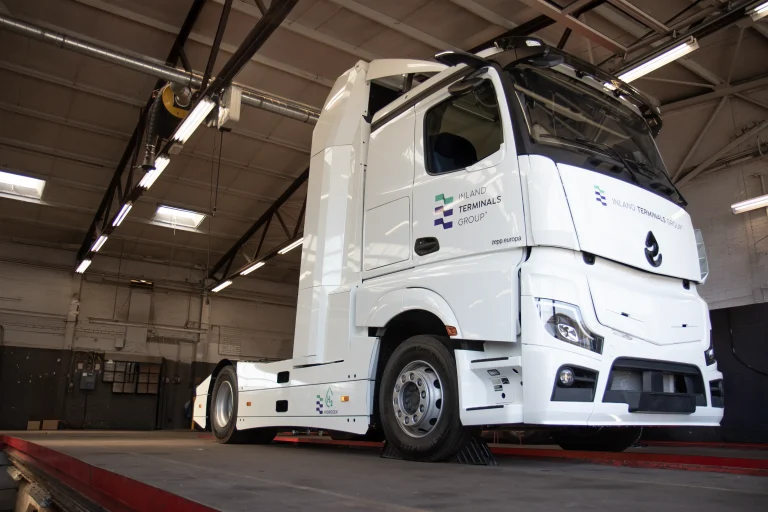
Zepp Europa: Discover How the Dutch X150 System Enables 42-Ton Haulage Over 1,000 km. Is This the End of the Diesel Era?
The Dutch Europa project is the first fully electric hydrogen-powered semi-truck designed to eliminate the typical limitations of zero-emission vehicles. Built on the proven Mercedes-Benz Actros chassis, the design combines the reliability of conventional trucks with the innovative fuel cell system from zepp.solutions.
1. Two Stages of Implementation: First Edition and Series Edition
The zepp.solutions strategy involves a gradual increase in range parameters by transitioning from 350-bar to 700-bar technology.
Technical Specifications Comparison:
| Feature | Europa First Edition (Q2 2025) | Europa Series Edition (Q3 2026) |
| Storage Pressure | 350 bar | 700 bar |
| Hydrogen Capacity (Usable) | 58.8 kg | > 80 kg |
| Operational Range (Loaded) | > 700 km | > 1,000 km |
| Electrical Energy (Post-conversion) | > 900 kWh | > 1,450 kWh |
| Base Chassis | Mercedes-Benz Actros | MB Actros ProCabin |
| Curb Weight | 10.6 t | $4\times2: <10$ t; $6\times2: <11$ t |
2. Drivetrain Efficiency and the X150 System
At the heart of both versions lies the X150 heavy-duty fuel cell system. This technology has been field-tested in demanding industrial applications and is also available as a standalone unit for integration into construction machinery or marine vessels.
- Cell Power: The system generates 150 kW of continuous power.
- Tractive Power: The vehicle offers over 400 kW of continuous tractive power, providing dynamics comparable to high-performance diesel units.
- Refueling Time: Regardless of the version, filling the tanks takes less than 20 minutes.
PEM Fuel Cell Systems
In our fuel cell systems, hydrogen combines with oxygen (drawn from the surrounding air) to convert the chemical energy stored in the fuel (hydrogen) and oxidant (oxygen) into electricity and water vapor. The electricity generated by this electrochemical reaction can power any application.
The Process: Hydrogen enters the fuel cell and splits into two protons and two electrons on the anode side. Any unreacted hydrogen is recirculated. Protons pass through the Proton Exchange Membrane (PEM) inside the cell, while electrons take a circuitous route. It is this flow of electrons that generates the electricity required to power the device. On the other side of the membrane (the cathode side), oxygen molecules ($O_2$) break down and combine with the protons and electrons to form water ($H_2O$).
Why Hydrogen? Advantages Over Battery Technology
Hydrogen fuel cell technology is particularly attractive for applications requiring high continuous power combined with long uptime. Current alternative energy storage systems, such as battery-electric (BEV), require long charging times, and the cost of such systems scales linearly with the required energy capacity.
In the case of batteries, doubling the energy requires doubling the number of cells, which doubles the cost. In hydrogen-electric systems, you only need to double the hydrogen tank capacity—the fuel cell itself remains unchanged. A further operational advantage is the ability to refuel almost instantly, which is a key competitive edge.
3. Logistics Without Barriers: Payload and Compatibility
A key argument for fleet operators is the maintenance of standard transport capabilities.
- Trailer Compatibility: Europa works with any standard ISO trailer (13.6 m / 45 ft) without requiring changes to the rig configuration.
- Gross Combined Weight Rating (GCWR): Utilizing EU regulations that increase the GCWR for Category N3 zero-emission vehicles from 40t to 42t, Europa offers a payload comparable to its lighter diesel counterparts.
- Maximum Rig Mass: Structurally, the vehicle is prepared for a 50-ton GCWR.
4. Driver Comfort and Safety
The design does not sacrifice the comfort essential for long-haul transport.
- Sleeper Cab: The Series Edition offers a double bed measuring $220 \times 75$ cm.
- Equipment: All options known from the Actros model are available, including a 25L refrigerator, coffee tables, and full-size slatted beds.
- Safety Standards: The vehicle features certified hydrogen leak detection and a ventilation system compliant with European standards.
Service and Market Availability
For customers outside the Netherlands (where the service network is already established), zepp.solutions utilizes a „flying doctor” model—dedicated system specialists support local service hubs in resolving technical issues.
First customer trials (First Edition) begin in Q2 2025, while mass production of the Series Edition with a 1,000 km range is planned for mid-2026.
Case Study: Hydrogen in the Circular Economy (Eska & ITG)
In February 2026, a key logistics partnership was announced, serving as a model for synergy between sustainable production and transport. Inland Terminals Group (ITG) deployed the Zepp Europa tractor to handle logistics for Eska—a global leader in high-quality graphic board production.
- A Full Sustainability Cycle: For Eska, choosing hydrogen is no accident. As a producer of 100% recycled cardboard, the company aims to minimize its carbon footprint at every stage.
- Real-World Technological Validation: During the official presentation in Midden-Groningen, Kevin Schreiber from zepp.solutions emphasized that hydrogen outperforms batteries in these specific applications:
- Heavy Loads: Transporting graphic board requires the high continuous power provided by the X150 module.
- Flexibility: With a range exceeding 700 km (First Edition), ITG can complete deliveries without planning multi-hour charging breaks.
Economic and Technical Benefits
Financial Aspect: Toll Exemptions (MAUT)
This is the strongest economic argument in Europe, as it effectively pays for the lease installments.
Note: Zero-emission vehicles like the Zepp Europa benefit from maximum discounts in road toll systems (e.g., German MAUT). For an international carrier, savings on tolls alone can reach €20,000 – €30,000 per year per vehicle. This is a crucial component of the TCO (Total Cost of Ownership), making hydrogen profitable faster than fuel prices alone might suggest.
Simplified Maintenance
The transition to Zepp hydrogen power also radically simplifies mechanical construction. The most failure-prone and expensive diesel components are eliminated:
- Exhaust Gas Recirculation (EGR)
- Diesel Particulate Filters (DPF)
- Complex SCR (AdBlue) systemsA fuel cell electric drivetrain means fewer moving parts and significantly longer service intervals.
Summary: Which Truck is for You?
| Feature | Battery Electric (BEV) | Zepp Europa (FCEV) |
| Typical Range | Up to 300 km | 500 – 1,000 km |
| Load Type | Lighter cargo | Heavy loads (42t) |
| Operation | Fixed loops, overnight charging | Multi-shift, international routes |
| Refueling | Hours (charging) | Under 20 minutes |