
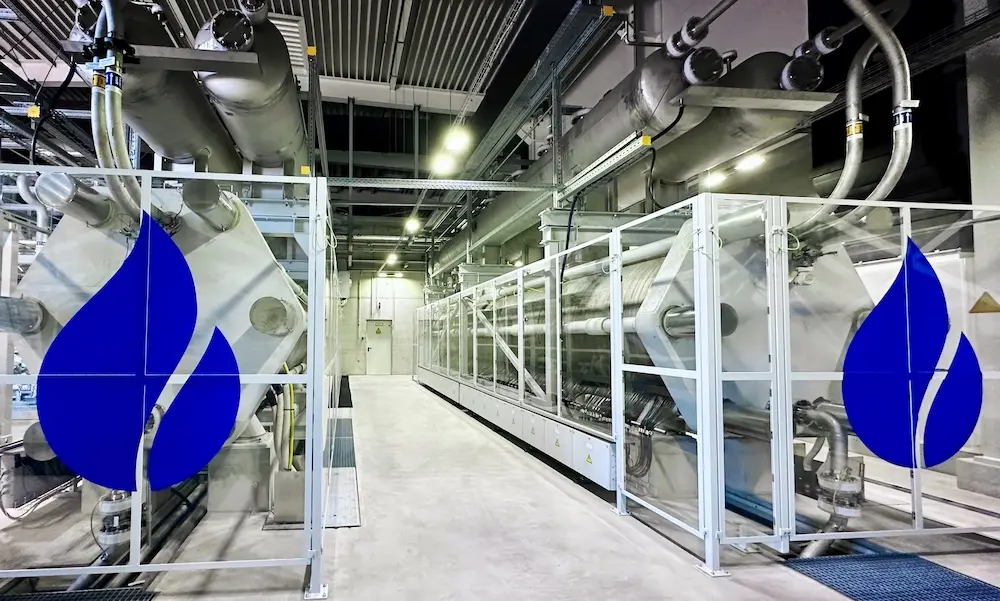
Sunfire SE Strengthens Leadership: 200 MW Capacity in Spain and the Triumph of Alkaline Technology
Sunfire vs. The Giants: The Great Hydrogen Technology Clash
In the world of green hydrogen, the battle is fought across three key parameters: efficiency, scalability, and cost (CAPEX).
Market Leaders Comparison Table (As of 2025/2026)
| Feature | Sunfire SE (Germany) | Nel Hydrogen (Norway) | tk nucera (Germany) | ITM Power (UK) |
| :— | :— | :— | :— | :— |
| Main Technology | SOEC (High-temp) + Alkaline | Alkaline + PEM | Alkaline (Large-scale) + SOEC | PEM |
| Efficiency (LHV) | 84% (Highest on market) | 63–71% | 62–68% | 65–70% |
| Business Model | Integration with heavy industry | Mass production, refueling stations | Gigaprojects (Industrial scale) | Modular PEM systems |
| Key Market | Steelworks, refineries, e-fuels | Transport, small & large scale | Chemicals, Ammonia (e.g., NEOM) | Refineries, projects with Linde |
| Financial Status | Private (Strong investor backing) | Public (Oslo Børs) | Public (IPO 2023, revenue leader) | Public (LSE) |
Where Sunfire Wins and Where It Competes?
- Advantage: SOEC Efficiency (Sunfire vs. The World)Sunfire outperforms the competition here. While Nel and ITM Power promote PEM (Proton Exchange Membrane) technology—which responds quickly to renewable energy fluctuations but is less energy-efficient—Sunfire bets on SOEC. If an industrial plant has free waste heat, a Sunfire SOEC electrolyzer requires 20-25% less electricity to produce the same amount of hydrogen than Nel or ITM devices.
- Scale: nucera as the „Goliath” of ProductionIn terms of order volume, thyssenkrupp nucera still dominates. Leveraging its legacy in the chlor-alkali industry, nucera can deliver 2 GW installations (e.g., the NEOM project). Sunfire is currently implementing 100 MW-scale projects (e.g., RWE), making them an innovation leader while closing the gap in total installed capacity.
- Flexibility: Nel & ITM Power vs. SunfirePEM technology is ideal for offshore wind farms due to its near-instantaneous response to voltage spikes. Sunfire’s SOEC, operating at 850°C, is a baseload technology designed for 24/7 continuous operation in refineries or steel mills.
Sunfire Secures 200 MW in Spain: A Milestone for Pressurized Alkaline Technology
In January 2026, German giant Sunfire SE announced orders for two large-scale electrolyzers totaling 200 MW for projects in Spain. This is one of the largest single orders in European hydrogen history, setting a new standard for refinery decarbonization.
The Winning Technology: Pressurized Alkaline Electrolysis
In the tender for Spanish energy giant Repsol, Sunfire’s pressurized alkaline technology emerged victorious. Why was this chosen over the high-efficiency SOEC?
- Scalability & Maturity: Sunfire will deliver 20 modules (10 MW each). Modularity allows for precise power management at an industrial scale.
- Refinery Integration: The 100 MW plants will be integrated into existing operations in Cartagena and Muskiz (Petronor refinery).
- Environmental Impact: Each 100 MW facility will produce up to 15,000 tons of green hydrogen annually, avoiding 167,000 tons of $CO_2$ emissions per year.
Sunfire SE in 2026: Fast Facts
- Workforce: Over 700 specialists in Germany.
- Leadership: Co-founders Nils Aldag (CEO) and Christian von Olshausen (CTO).
- Dual Portfolio: The only global player offering both Pressurized Alkaline (for GW-scale rapid deployment) and SOEC (for maximum efficiency).
- Headquarters: Dresden, Germany (Innovation & Decision Center).
Deep Dive: SOEC vs. Alkaline Specifications
Sunfire Technology Comparison Table
| Feature | Sunfire-HyLink (Alkaline) | Sunfire-HyLink (SOEC) |
| :— | :— | :— |
| Operating Temp. | Approx. 80–90°C | Approx. 850°C |
| Main Advantage | Reliability, high pressure | Extreme efficiency (Waste heat) |
| Application | Large-scale $H_2$ production | Refineries, steel, e-fuels |
| Maturity | Industrial proven (TRL 9) | Pioneering / Early-industrial |
| Output Pressure | Up to 30 bar (No extra compression) | Requires external compression |
| CAPEX | €1,000 – €1,400 / kW | €1,500 – €2,000 / kW |
| Durability | > 80,000 hours | < 40,000 hours (Ceramic degradation) |
Economic Analysis (CAPEX/OPEX)
- AEL (Alkaline): Sunfire is driving costs down through automation and its 500 MW/year factory in Germany. At energy prices of €40/MWh, the LCOH (Levelized Cost of Hydrogen) is estimated at €3–4.5/kg $H_2$.
- SOEC: While higher in CAPEX due to ceramic materials, it offers lower OPEX when integrated with waste heat. LCOH is estimated at €2.5–4/kg $H_2$ depending on cheap heat availability.
Strategic Analysis: Why didn’t Repsol choose SOEC?
While SOEC offers the highest efficiency, the 200 MW Spanish deal highlights market pragmatism. At this scale, bankability and technical maturity are paramount. Sunfire’s alkaline technology, based on 70 years of experience from its Swiss acquisition (IHT), guarantees operational continuity. By offering both technologies, Sunfire has successfully hedged against market uncertainty—a major competitive advantage over specialized rivals like Nel or ITM Power.
Author: Jan Frejowski, wodorowa.eu
Sources: Sunfire SE Corporate Data, IEA Electrolyzer Comparison Report, Repsol 2026 Strategy Update.