
The Financial Foundation of the PtX Revolution: European Energy and Mitsui Accelerate the Kassø Project
In the global race to decarbonize heavy transport, the Danish Kassø project has emerged as the absolute leader in the Power-to-X (PtX) sector. Securing additional financing through the partnership of European Energy and Japanese giant Mitsui & Co. is not just a commercial success; it is primary evidence of the economic efficiency of large-scale hydrogen projects. It signals to financial markets that green hydrogen and e-methanol are moving past the pilot phase into an era of mature industry.
Project Architecture: The World’s Largest e-Methanol Plant
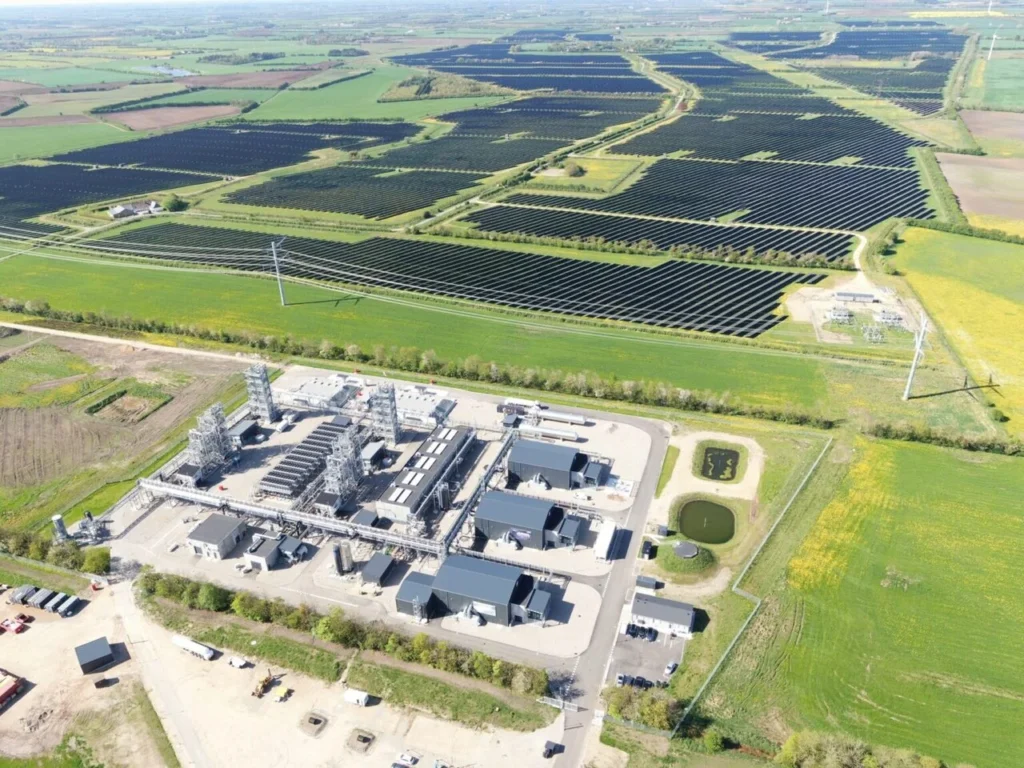
Located in Aabenraa municipality, Southern Denmark, the Kassø project is a unique integration of Northern Europe’s largest solar park (304 MW) with a 50 MW electrolysis plant and an e-methanol synthesis facility.
- Production: The plant is designed to produce up to 42,000 tons of e-methanol annually.
- Feedstock: Green hydrogen produced from solar energy is combined with biogenic carbon dioxide (captured from local biogas plants).
- Offtakers: Key binding offtake agreements have already been signed with global leaders: A.P. Moller – Maersk, LEGO Group, and Novo Nordisk.
Financing Structure and Strategic Partnership
The additional financing secured by European Energy and Mitsui culminates a transaction initiated in 2023, when Mitsui acquired a 49% stake in the project.
- Mitsui as a Catalyst: The Japanese conglomerate brings not only capital but also a global logistical network and expertise in chemical trading.
- Commercial Bank Role: The involvement of international financial institutions (including Nordea and SMBC) at this stage demonstrates confidence in electrolysis technology (supplied by Siemens Energy) and robust business models based on long-term offtake contracts.
- CAPEX Optimization: Additional funds are earmarked for finalizing commissioning and optimizing the $CO_2$ supply chain—critical for project margins.
SWOT Analysis: Kassø Project (Joint Venture European Energy & Mitsui)
| Strengths | Weaknesses |
| Vertical Integration: In-house RES (PV park) eliminates energy price volatility. | High CAPEX: PtX projects require massive initial outlays before generating profit. |
| Guaranteed Offtake: Contracts with Maersk ensure stable cash flow for decades. | Technical Complexity: Synchronizing electrolyzers with dynamic PV production. |
| Mitsui Partnership: Access to Japanese capital and Asian markets. |
| Opportunities | Threats |
| Model Scaling: Replication of Kassø’s success in other regions (e.g., Poland). | Regulatory Changes: Potential tightening of „green hydrogen” definitions in EU delegated acts. |
| E-Fuel Demand: IMO restrictions forcing shipowners to switch to methanol. | Competition: Cheaper e-methanol from regions with better solar conditions (e.g., North Africa, Chile). |
Innovation and Trial by Fire: Technical & Operational Insights
Kassø is a „living laboratory” where engineering theory met the reality of supply chain disruptions and evolving regulations.
1. The Heart of the System: Electrolysis and Synthesis
The foundation is PEM (Proton Exchange Membrane) technology from Siemens Energy.
- Silyzer 300 Specifics: The 50 MW system consists of modules with high dynamic range. PEM technology responds to load changes in milliseconds—crucial when directly connected to a 304 MW solar farm. If a cloud covers the sun, hydrogen production is immediately adjusted to prevent system destabilization.
- Innovation in Synthesis: European Energy uses a proprietary approach to thermal optimization. Biogenic $CO_2$ ensures the fuel is classified as RFNBO (Renewable Fuels of Non-Biological Origin) under RED II. Advanced copper-zinc catalysts are optimized for pure electrolytic hydrogen.
2. Anatomy of Challenges: Lessons Learned
- Supply Chain Crunch: Originally planned for earlier operation, the war in Ukraine and post-pandemic logistics for electronic components (inverters/PLC systems) caused delays.
- The Struggle for „Additionality”: Developers had to prove the solar park would not have been built without the hydrogen project and that it doesn’t „take” green energy from the grid needed by households. This forced a complex „behind-the-meter” architecture.
- Waste Heat Management: Both electrolysis and synthesis are exothermic. Initially a cooling challenge, the solution was integration with the local district heating network, turning a technical problem into a revenue stream.
3. Engineering „Hidden Gems”
- Ultra-Pure Water: The system uses a closed circuit of demineralized water. PEM membranes require conductivity below 0.1 μS/cm; any heavy metal contamination would destroy millions of euros in equipment.
- Digital Twin: A full digital model simulates production based on 48-hour weather forecasts, automatically planning maintenance cycles or optimizing pressure in hydrogen buffer tanks.
The Power-to-X Era: Global Logistics and Daily Life
Mitsui experts emphasize that e-methanol reduces GHG emissions by over 95%. While it has lower energy density than heavy fuel oil (requiring 2.5x larger tanks), its liquid state at room temperature makes it cheaper to distribute than ammonia or cryogenic hydrogen.
Beyond Fuel: LEGO and Medicine
- LEGO Group: Uses e-methanol as a raw material for Polyoxymethylene (POM)—the high-strength plastic used for wheel axles in LEGO sets.
- Novo Nordisk: Plans to use „green plastic” for insulin pens and medical devices.
„Most methanol today comes from natural gas. My dream is a future where e-methanol replaces it in every everyday product—from toys to medicine.” — Taiha Kaneko, Mitsui & Co.
Technical and Financial Verification (As of 2026)
| Parameter | Verified Value | Notes |
| PV Capacity | 304 MW | Largest in Northern Europe. |
| Electrolysis Capacity | 52.5 MW | 3 x 17.5 MW Siemens Energy PEM units. |
| Annual Production | 42,000 tons | Equivalent to approx. 53 million liters of fuel. |
| CO2 Feedstock | 45,000 tons | Biogenic origin from local dairies/biogas. |
| Ownership | EE (51%) / Mitsui (49%) | Special Purpose Vehicle: Solar Park Kassø ApS. |
| Heat Recovery | 2,500 households | Supplying Aabenraa district heating. |
Financial Stability in the Operational Phase
In January 2026, the partnership secured a green financing bridge facility involving Nordea and SMBC, with a partial guarantee from the Danish fund EIFO. This confirms that Kassø has successfully transitioned from a risky tech startup to a stable industrial asset.
Analysis by: Jan Frejowski, wodorowa.eu
Sources: European Energy Corporate Announcements (2024-2025), Mitsui & Co. Strategic Investment Reports, A.P. Moller – Maersk Sustainability Updates, EIFO Green-Financing Bridge Facility records.